Pam McDonald, author of
The Apo E Gene Diet: A Breakthrough in Changing Cholesterol, Weight, Heart and Alzheimer's Using the Body's Own Genes
, contacted me to offer a free article on treating and preventing Alzheimer's through a specialized diet.
You can contact Ms McDonald through her
website.
Here it is. I hope it will be of interest and benefit.
The ApoE Gene Diet – An Integrative Medicine Approach to Disease Prevention.
Introduction To The Apo E Gene
We all have the Apo E gene (pronounced by saying each letter, A - P - O - E). This gene plays a key role in our body's internal environment and is a determining factor in the development of chronic disease, especially heart disease and Alzheimer’s disease.
Keep in mind – Heart disease and Alzheimer’s disease are two inflammatory diseases. Our goal is to create a "gene-supportive environment" (GSE), based your individual Apo E genotype and reduce inflammation in the body specifically in the arteries, heart and brain.
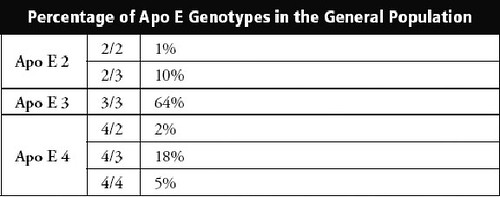
The Apo E gene occurs as three variations, or alleles, in humans: Apo E 2, Apo E 3, and Apo E 4. Since genes come in matching pairs, we each have two alleles of every gene, one from each parent. If you received an Apo E 2 from one parent and an Apo E 3 from the other parent, your genotype would be E 2/3. The six possible combinations of Apo E gene pairs are E 2/2, E 2/3, E 3/3, E 4/2, E 4/3, and E 4/4.
How Your Apo E Genotype Affects Your Health
As you can see from the table below, the most common genotype, Apo E 3/3, is found in approximately 64 percent of the population. It is considered the “neutral” Apo E genotype. Combinations that include either the Apo E 2 or Apo E 4 are considered “alternative” expressions of the more common Apo E 3 pairing. People with Apo E 2 or 4 alleles will process foods differently from the way in which an Apo E 3’s body will.
The APOE Gene Diet can help prevent Alzheimer's disease and Heart disease.
The specific pair of Apo E genes you inherited from your parents greatly influences your predisposition to certain illnesses, including heart disease, vascular dementia, Alzheimer's disease, Parkinson's disease, and cancer. For example, persons with the Apo E 4/4 genotype could have up to a 90 percent chance of developing a chronic illness such as Alzheimer's disease. Maintaining an optimal diet and lifestyle for your particular Apo E genotype is known as maintaining a "gene-supportive environment" (GSE), and doing so can dramatically reduce your risk of developing these chronic illnesses. That's why the Apo E Gene Diet was created.
The Apo E Gene Diet
The foundation of the Apo E Gene Diet is a nutritional plan that focuses on eating the optimal percentages of "The Big Three" - carbohydrates, fats and proteins - for your specific Apo E genotype. One diet does not fit all because each Apo E genotype processes foods differently. There is a unique optimal combination of carbohydrates, fats, and proteins which creates the ideal diet for each of the six Apo E genotypes. Creating this optimal balance in your diet provides the foundation for your good health.
The Apo E gene has been shown to be the number one factor affecting how your body uses The Big Three macronutrients or food groups, and this influences the possibility and severity of developing certain diseases. It is extremely important to eat the right balance of carbohydrates, fats and proteins for your specific Apo E genotype.
The Apo E Gene Diet is not a diet in the typical sense of the word. With the Apo E Gene Diet, we use the word "diet" to mean a series of specific recommendations for individual nutrition and other environmental factors, such as exercise and stress levels, to name a few. The goal of the Apo E Gene Diet is disease prevention and a healthy life; it is a personalized plan for your Apo E genotype which will guide you in choosing the optimal:
• fat content with the correct types of fats
• carbohydrate content with the correct types of carbohydrates
• protein content with the correct types of proteins
• caloric content for your needs
• amount and kind of exercise appropriate for you
• balance of stress and relaxation in your life
• quality of mental and emotional environment
• type of energy and intentions you allow into your life (the spiritual component)
Most of the existing dietary recommendations are based on the assumption that one diet plan is appropriate for everyone. Because of that assumption, those diets fail to accomplish long-term weight loss or optimal disease prevention. We are not all the same. In reality, diet and exercise recommendations must be individualized, beginning with a person's genetic foundational recipe.
The Apo E Gene Diet focuses on an individual’s genetic recipe, creating dietary and exercise recommendations for each of the six possible Apo E genotypes a person can have. No other program does this. In addition, the Apo E Gene Diet takes into account the whole person (physical, emotional, and spiritual) in creating a gene-supportive environment which promotes a healthy life, free of chronic illnesses.
The Optimal Diet and Lifestyle For Your Apo E Genotype
So how do you create the optimal diet and lifestyle for your particular Apo E genotype? There are three steps.
1. First, consider reading
The Apo E Gene Diet: A Breakthrough in Changing Cholesterol, Weight, Heart and Alzheimer's Using the Body's Own Genes by Pamela McDonald.
2. After reading the book, you can make an informed decision as to whether you want to know your Apo E genotype. Finding out which Apo E genotype you have is done through a simple cheek swab test or non-fasting blood test (more information on testing options).
3. Once you know your Apo E genotype, follow the diet and lifestyle plan outlined in the book for your particular Apo E genotype.
Following these three steps will support you on the path to a healthy life, free of chronic disease.
My experience in supporting patients in implementing the changes
required by the Apo E Gene Diet has led me to develop a number of general
recommendations that apply to all, regardless of their particular genotype.
Recommendations for Implementing The Apo E Gene Diet
In order to make changes in a current lifestyle, the following general
recommendations will help you be successful in those changes.
• Use the principles of integrative medicine that:
• take into account the whole person—body, mind, emotions, spirit,
environment, and lifestyle
• emphasize a supportive, caring, therapeutic relationship
• make use of all appropriate therapies, both conventional and
alternative, and
• use culturally appropriate, natural, effective, minimally invasive
interventions whenever possible
Find a practitioner who is:
• trained in integrative medicine, since nutrition and exercise are
two very powerful tools of integrative medicine
• committed to a healthy lifestyle, self-exploration, and self-development
You will then be guided and supported in:
• stimulating your body’s innate healing with foods that match its
genetic instructions
• utilizing all three food categories (fats, proteins, carbohydrates) in
an optimal balance for your genotype (unless a medical condition
prevents this)
• focusing on foods that do not cause inflammation and are easily
assimilated, metabolized, and cleared by your body
• counting all calories (if weight is an issue)
• choosing natural, whole (that is, unprocessed) foods whenever possible
• utilizing routine blood chemistries and physical evaluations to
make adjustments as treatment progresses
• implementing the exercise program that is best for your individual
Apo E genotype
Apo E Gene Testing—Should I Do It?
Apo E gene testing offers the beginning of improved health and a happier life for many people. Once you know your Apo E gene type, a clear personalized dietary, exercise, and general wellness program provides you with the key to preventing heart disease, Alzheimer's disease, and many other chronic illnesses.
However, we recommend that you be tested only if you are willing to follow the personalized diet and lifestyle program that creates the most supportive environment for your Apo E gene type.
The decision to be tested is a very personal one. Some people want to be tested to learn the appropriate diet and lifestyle for their particular Apo E genotype, thereby minimizing their risk of developing chronic disease. Other people prefer not to know their genetic predisposition toward certain chronic diseases—clearly, this test is not for them.
The best way to make a fully informed decision as to whether you should be tested is to read the book, The APO E Gene Diet, by Pamela McDonald. Otherwise, there are several basic questions that you can ask yourself when considering whether you want to be tested:
1. Why do I want to learn my Apo E gene type?
2. Once I get my results, am I willing to follow the recommended diet, exercise, and wellness program best for my gene type?
3. Who is going to support me in undertaking any lifestyle change program?
If you do decide to be tested and embark on our APO E GENE DIET and HearthHealth Watchers™ program, we offer guidance and a unique collection of tools for a sustainable lifestyle that will bring you a renewed sense of health and wellbeing. A holistic assessment and life-balancing program, the Wellness Inventory, will help you gain personal insight into your state of physical, mental, emotional, and spiritual wellness. Personalized telephone consulting rounds out the program.
www.apoegenediet.comPamela McDonald FA,FNP Integrative Medicine Fellow.